On Global Accessibility Awareness Day (GAAD), we’re reminded how much of everyday life now happens online – and how easily people can be excluded when digital spaces aren’t designed with everyone in mind.
Being offline in 2026 doesn’t just make life harder – it can stop people taking part at all.
From applying for jobs and learning new skills to booking GP appointments or staying in touch with family, digital access now shapes everyday life. Without it, people can be locked out of opportunities most of us take for granted.
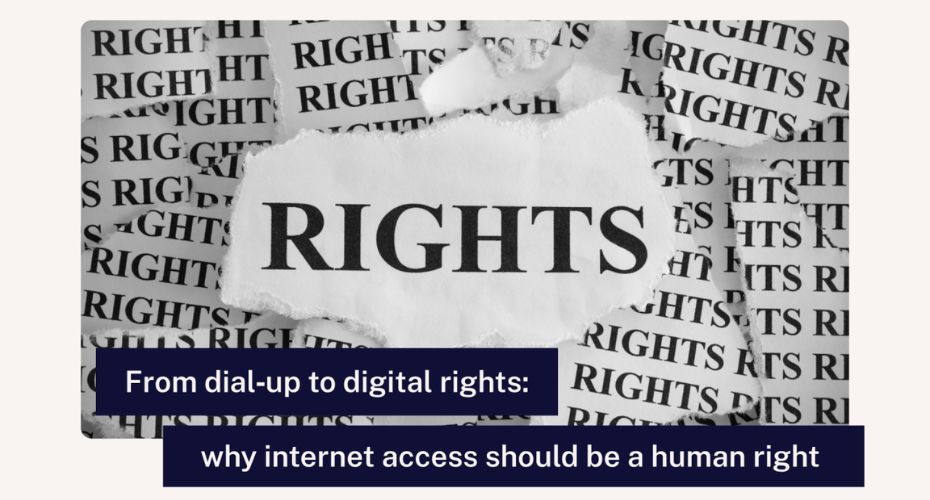
But internet access hasn’t always been seen as essential, let alone something people should have a right to. So how did we get here?
As we mark GAAD, it’s a good time to look at how internet access came to be seen as more than a convenience – and why it’s increasingly recognised as a fundamental part of modern society.
Before Wi‑Fi: the right to information
The idea behind digital access goes back much further than the internet itself.
In 1948, the Universal Declaration of Human Rights set out the right to freedom of expression and access to information. It includes the right to “seek, receive and impart information and ideas through any media”.
At the time, that meant newspapers, radio and print. Today, it’s widely understood to include digital spaces too. The technology has changed, but the principle hasn’t: people should be able to access information and share their views.
The internet arrives (and the digital divide with it)
When the internet expanded rapidly in the 1990s, it transformed how people communicate, learn and work. But it also exposed growing inequalities.
Some people gained fast, reliable access and new opportunities. Others were left behind because of cost, skills, location or support needs. This gap became known as the digital divide – and it still affects millions of people today.
Offline rights apply online too
In 2016, the United Nations made an important statement: the same human rights people have offline must also be protected online.
That matters because more and more essential services now exist primarily in digital spaces. If people can’t get online, or can’t use digital services easily, their rights in practice can be limited – even if those rights exist on paper.
More than just a connection: accessibility matters
Digital access isn’t only about having an internet connection.
If websites, apps or online services aren’t accessible, disabled people can be shut out altogether. Small barriers – like unclear layouts, unreadable text or forms that don’t work with assistive technology – can make a service impossible to use.
Accessibility standards and the law
Guidelines like the Web Content Accessibility Guidelines (WCAG), alongside the Equality Act 2010, are designed to make sure digital spaces are usable by as many people as possible. In the UK, the Equality Act also places a legal duty on organisations to make reasonable adjustments so disabled people are not disadvantaged.
Accessibility isn’t an optional extra. It’s part of creating a fairer digital world where people aren’t excluded because of how something is designed.
Covid‑19: when digital access became essential
The Covid‑19 pandemic made the importance of digital access impossible to ignore.
Almost overnight, work, education, healthcare and support services moved online. For people without reliable access, devices or digital skills, everyday life became even harder.
The pandemic didn’t create digital inequality – but it made its impact clearer than ever.
Where does that leave us today?
Today, digital access is widely recognised as a gateway to taking part in modern society.
But recognition alone isn’t enough. If we want a digital world that works for everyone, we need to think beyond connection and focus on inclusion, accessibility and support.
The challenge ahead isn’t just getting people online – it’s making sure the digital world works for everyone.
That means designing services with people in mind, removing barriers and recognising digital access as a basic part of everyday life, not a privilege for the few.
Want to know how accessible your website is?
Use our free snapshot test for a quick overview of how accessible your website is. For a more detailed audit, email Accessibility-Services@Shaw-Trust.org.uk.
Written by Accessibility Assessor Alan Sleat.